EN
EN  FR
FR  DE
DE  RU
RU  ES
ES  PT
PT  AR
AR  JA
JA 
The hinge arm is the primary structural link between a door and its mounting. Material choice for that arm determines how cabinet hinges behave under repeated use: fatigue life, deformation, corrosion tolerance, and where stress concentrates. For B2B buyers—OEMs, cabinet manufacturers, and project specifiers—material is not an aesthetic detail; it’s a lifetime-performance decision.
As a professional hinge manufacturer, Mingrun explains the engineering differences between zinc alloy, cold-rolled steel (CRS), and stainless steel for hinge arm construction, and offers practical selection guidance based on fatigue resistance and long-term stress points.
What is the Duty of A Hinge Arm
A cabinet hinge arm transmits bending moments, shear, and torsion from the door to the cup and mounting plate. Key mechanical demands include:
- Repeated cyclic loading (opening/closing cycles)
- Localized stress around the pivot pin and crank bends
- Resistance to creep or permanent set under sustained load (heavy doors)
- Compatibility with surface treatments (plating, PVD, passivation) for corrosion protection
Material choice defines how well the arm meets these demands and what compensating design features are necessary.
Zinc Alloy: Low Cost, Limited Fatigue Endurance
Characteristics
- Manufactured mainly by die casting (zinc die-cast alloys such as ZAMAK)
- Good for complex geometries with low tooling cost
- Relatively heavy compared to stamped steel at equivalent thickness
Strengths
- Low material and tooling costs for decorative or low-volume lines
- Good dimensional detail for integrated features (clips, pockets)
Weaknesses (engineering impact)
- Lower fatigue strength and ductility compared with steels — crank bends and thin sections develop microcracks over cycles.
- Creep and stress relaxation under constant load can lead to sagging in heavy doors.
- Porosity and casting defects (if process control is poor) accelerate failure.
When to use
- Commercially, Mingrun recommends hinges with zinc alloy hinge arms for light doors, low-cycle residential use, or decorative hinges where price is the overriding driver. Avoid for heavy, high-use, or exterior applications.
Cold-rolled Steel (CRS): Balanced Performance with Surface Treatment
Characteristics
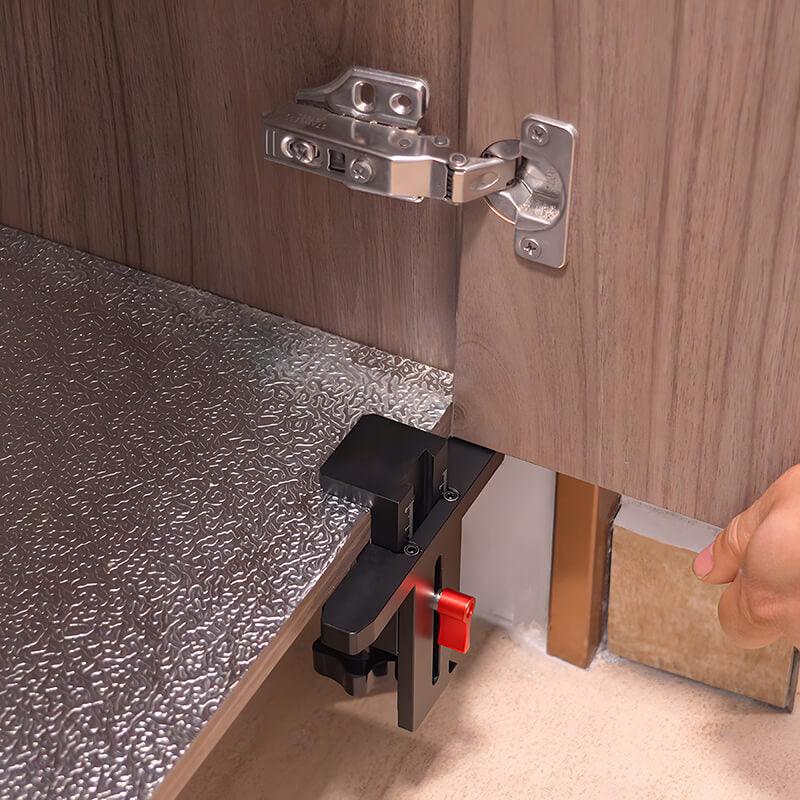
- Produced by stamping and forming from cold-rolled coils; often used for stamped hinge arm designs.
- High tensile strength and good formability for ribs and bends.
Strengths
- Better fatigue resistance than zinc — suitable for medium-duty applications.
- Easier to add structural ribs and flanges to control stress concentrations at cranks.
- Compatible with a wide range of surface finishes (nickel/chrome plating, PVD after appropriate pretreatment).
Weaknesses (engineering impact)
- Steel corrodes without proper treatment; plating adhesion, pretreatment, and passivation quality directly affect long-term performance.
- Heavier than some optimized zinc parts; stamping tolerances must be controlled to avoid variability in pivot clearance.
When to use
- Mid-range product lines and applications requiring better cycle life than zinc but lower cost than stainless. Ensure rigorous plating processes and SPC on forming tolerances.
Stainless Steel (304 / 316): Premium Durability and Corrosion Resistance
Characteristics
- Austenitic stainless steels (304, 316) are used for machined, stamped, or laser-cut hinge arm parts.
- Excellent corrosion resistance and higher fatigue life in corrosive environments.
Strengths
- Highest fatigue resistance of the three materials; maintains dimensional stability over very high cycle counts.
- Superior performance in aggressive environments (kitchens, bathrooms, coastal installations) without plating.
- Lower maintenance and minimal risk of galvanic corrosion when correctly paired.
Weaknesses (engineering impact)
- Higher material and fabrication costs; forming and machining stainless steel require stronger tooling and sometimes different processes.
- Surface finish options differ—PVD or electropolishing may be used for aesthetics, but are typically not functionally necessary.
When to use
- Heavy doors, commercial/high-cycle installations, and environments where corrosion resistance is critical. Preferred where life-cycle cost and warranty risk dominate procurement decisions.
Fatigue Resistance and Long-Term Stress Points
Fatigue failures commonly initiate at a few predictable hinge arm locations:
- Crank bends, and radii — peak tensile/compressive stress cycles occur here. Small radii or sharp corners concentrate stress.
- Pivot bore and pin hole — fretting and micro-movement create wear paths; material hardness and pin fit matter.
- Thin cross-sections near ribs — thinning reduces safety margin; stamping tolerances must be controlled.
- Attachment bosses around the cup area — pull-out under torsional load is a risk.
Material mitigations:
- Zinc: increase cross-section, add ribs, avoid thin walls at bends; accept lower fatigue life.
- CRS: use proper radii and stamping control; apply corrosion protection and confirm plating adhesion.
- Stainless steel: design for minimal over-engineering; exploit superior fatigue performance to reduce part mass or simplify reinforcement.
Design and Test Expectations for B2B Buyers
When qualifying cabinet hinge suppliers, require measurable proof, not claims:
- Fatigue testing: specify cycle counts that match the use case (e.g., 50k residential; 100k+ commercial).
- Pull-out and torque tests: for screw fixation and pivot pins.
- Fretting and wear tests: where pin-to-bore interaction is critical.
- Material certificates: alloy grade, composition, and heat-treatment records.
- SPC data: dimensional tolerances for critical crank radii and thicknesses.
Cost Vs. Reliability Trade-off (Practical Guidance)
- For budget consumer products, zinc alloy hinge arm designs can be acceptable if door weight and expected cycles are low and if tooling quality is controlled.
- For mainstream residential and multi-unit projects, CRS arms with robust plating are the pragmatic middle ground.
- For commercial, high-use, coastal, or warranty-sensitive applications, stainless steel arms are justified by lower lifecycle costs and fewer field failures.
Conclusion
Selecting a hinge arm material should follow the expected door mass, cycle density, environment, and warranty policy. Zinc, CRS, and stainless steel each occupy rational niches—understanding their fatigue behavior and long-term stress hotspots enables buyers to align specification, testing, and procurement to reduce failures and claims. Insist on data-driven validation from suppliers: material certificates, fatigue tests, and SPC records are the difference between a one-off sample and a reliably performing hinge program.
About Mingrun
Mingrun is a dedicated cabinet hinge manufacturer supplying complete hinges for brands, furniture factories, and project contractors. With controlled steel sourcing and consistent material batches, we maintain stable forming accuracy, pivot strength, and long-cycle performance across mass production.
Our production covers zinc alloy, cold-rolled steel, and stainless steel hinge structures to match different load and corrosion requirements. For B2B customers, Mingrun provides cabinet hinge OEM/ODM customization, including arm geometry, surface finishing, plating options, packaging, and branding, enabling a reliable hinge supply for both standard and engineered hinge programs.